Did you know that up to 70% of credit applications in South Africa are rejected?
Not always because the risk is high, but often because financial visibility is low.
Many economically active South Africans earn, spend and build businesses every day, yet remain poorly represented in traditional financial datasets.
When the data lens is narrow, financial decisions become narrow too.
South Africa’s Economic Reality
South Africa’s economy is far more dynamic than our financial datasets often reflect.
According to FinMark Trust, approximately 8.2 million South Africans are employed in the informal sector. Millions earn income through:
- informal work
- micro-enterprises
- seasonal labour
- gig platforms
- hybrid income sources
This economic activity is real.
But much of it is not fully captured in traditional credit and financial data systems.
When lenders cannot see the full picture, the result is often simple: Decline.
Financial inclusion is not only a capital problem – it is also a data visibility problem.
Open Banking: The First Layer of Visibility
Open Banking is an important step toward improving this situation. By enabling access to bank transaction data, lenders are able to assess:
- income patterns
- cash flow behaviour
- spending habits
- affordability signals
The benefits are significant:
- reduced fraud
- improved underwriting accuracy
- faster digital onboarding
- greater competition in financial services
Frameworks focused on banking data portability are now operational in several major economies.
The United Kingdom and European Union introduced regulated Open Banking frameworks in 2018, enabling secure sharing of bank account and payment data through APIs. Similar initiatives have emerged in markets such as India and Singapore, where banking data access is supporting digital financial innovation.
Open Banking represents a meaningful shift toward improving financial transparency.
However, it primarily improves visibility for consumers already integrated into the formal banking system. And South Africa’s economy extends well beyond that.
Open Finance: Expanding the Financial Picture
The next stage in the evolution of financial data ecosystems is Open Finance.
Open Finance builds on Open Banking by incorporating additional financial datasets such as:
- insurance information
- savings and investment data
- credit product data
- broader financial services information
This creates richer financial profiles and enables more informed financial decision-making.
Several international markets are progressing in this direction. For example, Brazil’s Open Finance framework integrates banking, credit, insurance and investment data into a unified ecosystem. Similarly, Australia’s Consumer Data Right allows consumers to securely share financial product data across institutions, expanding visibility beyond traditional banking relationships.
In these markets, broader financial datasets have strengthened competition, product innovation and consumer empowerment. In South Africa, regulators are currently exploring how Open Finance could evolve within the local financial ecosystem.
Open Data: Expanding the Data Universe
The next natural step in this evolution is Open Data. Open Data expands visibility beyond financial institutions to include broader economic signals such as:
- mobile and telco data
- digital wallet transactions
- gig and platform income
- alternative payroll signals
- municipal payment histories
- behavioural financial indicators
Expanding the data lens allows lenders to better understand consumers who are currently thin-file or financially invisible.
Globally, several economies are already beginning to move toward this broader Smart Data model.
In the United Kingdom, policymakers are expanding Open Banking toward a wider Smart Data ecosystem, enabling consumer-permissioned data sharing across sectors such as energy, telecommunications and pensions. Australia’s Consumer Data Right has already extended beyond banking into the energy sector and is expected to expand further across additional industries.
These developments illustrate a broader structural trend: data ecosystems rarely remain limited to banking data alone. As frameworks mature, they expand toward richer financial datasets and eventually broader economic data signals.
The goal is not to lower lending standards. It is to improve decision accuracy.
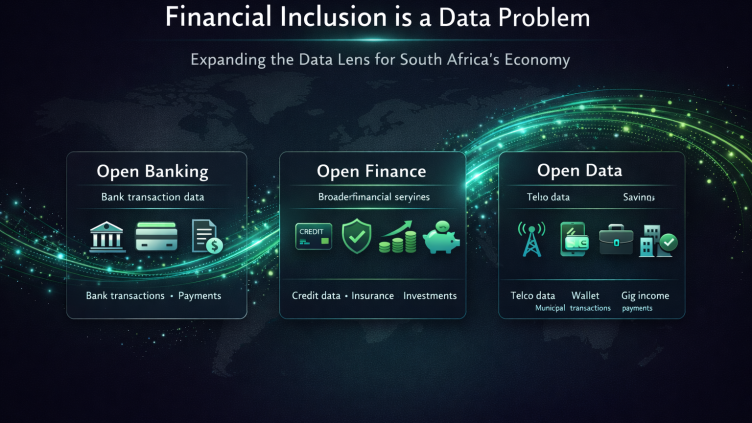
The Natural Evolution of Financial Data
Across global markets, financial data ecosystems rarely remain limited to banking data alone. As frameworks mature, they expand progressively:
Open Banking → Bank transaction data
Open Finance → Broader financial services data
Open Data → Economy-wide behavioural data
Each step expands the information available for better financial decision-making. South Africa is currently making meaningful progress along this journey.
Figure: The Evolution of Financial Data Ecosystems

Better data leads to better financial decisions — for lenders, businesses and the broader economy.
Why This Matters for South Africa
When 8.2 million people operate in the informal sector, traditional financial datasets capture only part of the economic picture.
Improving financial visibility can support several national economic priorities highlighted in the President’s State of the Nation Address (SONA).
SME job creation
The President noted that if every SME hired just one additional employee, South Africa could create up to three million jobs.
Yet many small businesses struggle to access funding.
Improving financial visibility allows lenders to better assess SMEs and informal entrepreneurs, expanding responsible access to capital.
Research also suggests that a 10% improvement in financial inclusion could unlock up to R30 billion in additional economic activity.
Digital economic inclusion
Government has also prioritised digital transformation as a driver of growth, inclusion and improved service delivery.
Responsible data ecosystems play a key role in enabling individuals and small businesses to participate more fully in the formal financial system.
The Economic Multiplier
Improving financial visibility can unlock:
- SME and township business growth
- stronger household financial resilience
- increased productive credit allocation
- broader economic participation
Financial inclusion is therefore not only a capital problem – it is also a data problem.
A Collaborative Path Forward
Encouragingly, South Africa is already taking important steps toward a more open financial data ecosystem.
Regulators, financial institutions, fintechs and industry bodies are actively working together to develop Open Banking frameworks and data-sharing standards that prioritise:
- consumer consent
- security and privacy
- responsible innovation
- fair competition
These initiatives represent critical building blocks for the future of financial inclusion.
They demonstrate a constructive and collaborative approach to modernising South Africa’s financial data infrastructure.
The evolution of financial data ecosystems is not simply a technological shift – it is an economic opportunity to expand responsible access to capital across South Africa.