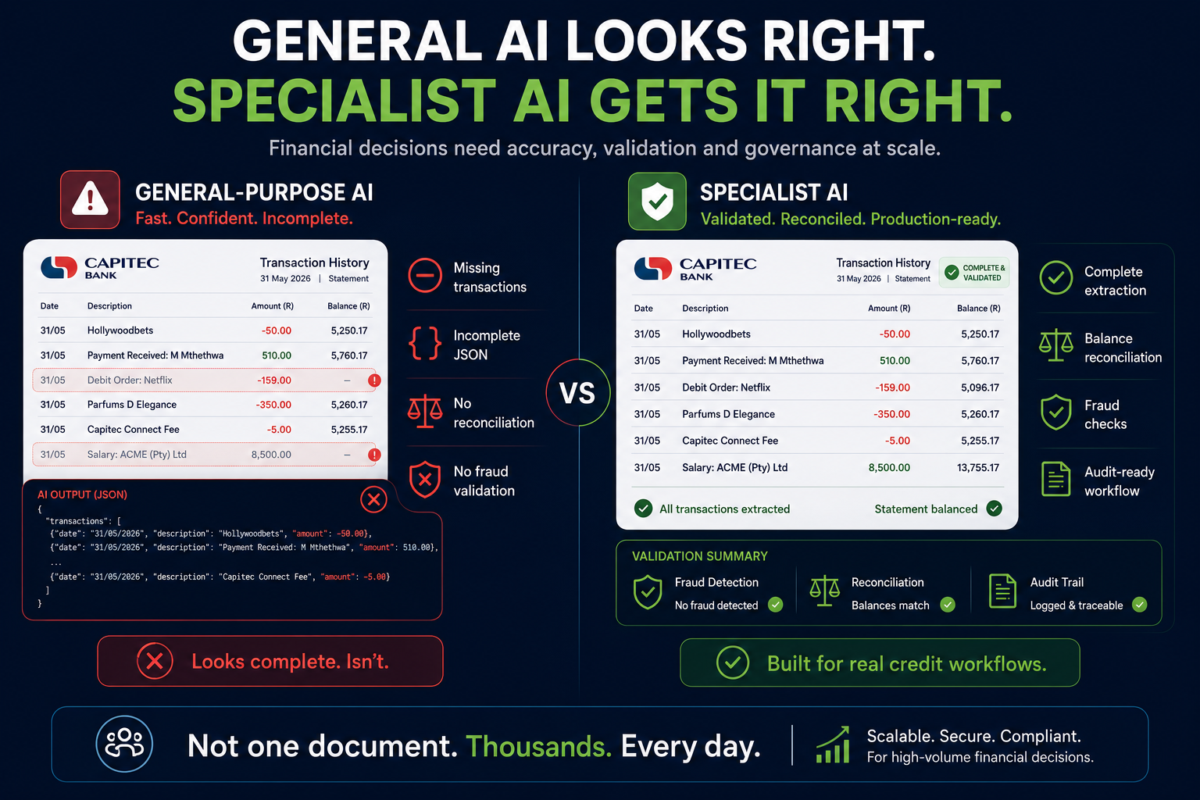
The most dangerous AI output in financial services is not one that looks wrong.
It is one that looks right, but isn’t.
Over the past few months, clients have been asking us a fair question:
“Can’t we just upload customer bank statements into ChatGPT or Claude and get the same result?”
It’s a fair question. So we tested it.
We took a clean electronic bank statement directly from the bank, uploaded it into one of today’s most advanced frontier AI models, and asked it to:
✅ Extract every transaction
✅ Return structured JSON
✅ Categorise every transaction
✅ Detect document fraud
The response came back in seconds.
It looked excellent.
Unfortunately, it was also wrong.
The model missed debit transactions, missed credit transactions, omitted entire sections of the statement, produced incomplete JSON, and failed to identify a fraudulent statement that truID’s own fraud engine detected immediately.
What surprised us most wasn’t just the mistakes.
It was the confidence.
There was no indication that anything had been missed. No confidence score. No warning. No reconciliation failure. Just an answer that looked complete.
That’s a dangerous combination in financial services.
When bank statements are used for lending decisions, affordability assessments, income verification or fraud detection, “almost right” isn’t right enough.
One missing salary payment.
One missed debit order.
One fraudulent document accepted as genuine.
These are not small errors. They materially change business outcomes.
And at production scale, the problem becomes even bigger.
Financial services providers are not processing one statement in isolation. They are processing thousands of documents across multiple banks, formats, layouts, edge cases and fraud attempts.
The real question is not whether AI can read one document.
It is whether the system can process large volumes of sensitive financial documents reliably, consistently, securely and cost-effectively inside a live credit workflow.
That is where specialist AI matters.
General-purpose AI is powerful, but it does not automatically provide the controls required for financial services: validation, reconciliation, fraud detection, exception handling, auditability, monitoring, business rules and governance.
Cost is another consideration.
Processing an entire bank statement through a leading frontier model can cost around R2 per page in AI inference alone. Smaller models can reduce this cost, but in our testing, extraction quality deteriorated as model size decreased.
Lower cost.
Higher error rates.
More operational risk.
Then there is data governance.
Bank statements contain highly sensitive personal information. Before uploading customer statements into any AI platform, organisations should ask where the data is processed, where it is stored, whether it leaves South Africa, who has access to it, and whether the deployment aligns with POPIA and internal information security policies.
This is why specialist AI still matters.
truID’s OCR technology is not simply “AI reading a bank statement.”
It is a specialist document intelligence layer built for financial services workflows, combining extraction, validation, reconciliation, fraud detection, categorisation, business rules and production infrastructure.
The objective is not just to extract data.
It is to produce data that is accurate, complete, structured, trusted and usable in real credit and operational decisioning.
The lesson from our test was not that AI does not work.
It was that intelligence alone is not enough.
For regulated industries, specialist AI is not competing with general-purpose AI.
It is solving a different problem entirely.
3 responses to “General-Purpose AI vs Specialist AI: Can it be trusted?”
Loan application transfer
I needed it for loand that’s approved
juanraynel50@gmail.com