In 2024, South Africans submitted 70.8 million applications for credit. Lenders declined 47.5 million of them. Two out of every three, and that ratio has been climbing for most of two decades – at the end of 2007 it was closer to four in ten.
Not all of that is a visibility problem. Plenty of those declines are affordability, over-indebtedness, or a lender’s appetite on the day, and some are the system working exactly as it should. But a meaningful share are people who were turned away because there was no data to assess them with.
A third of the people it can see are already in trouble
Look first at who the system can already see. South Africa’s credit bureaus hold records for 29.24 million credit-active consumers, and 10.54 million of them carry an impaired record. More than a third of the people the system can see are already in trouble on paper.
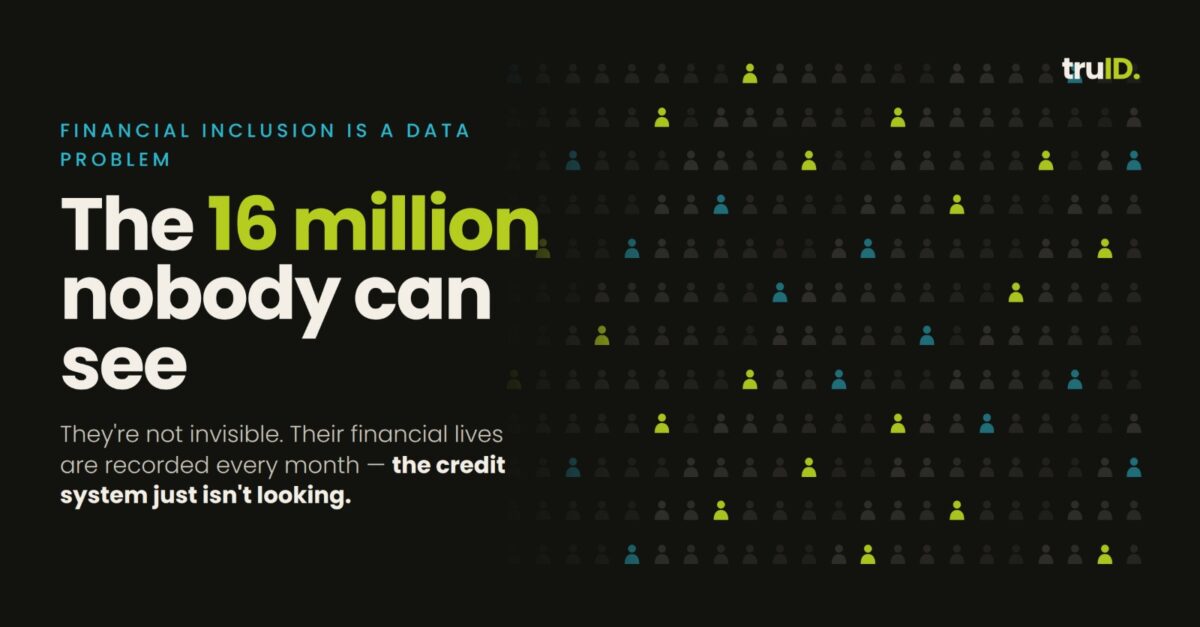
Then there are roughly 16 million more with no usable bureau record at all.
“Invisible” is the wrong word
The bureaus call them invisible, but they are not – traditional credit systems simply do not know how to look at the data these consumers already generate. The word misleads: it suggests someone outside the system – unbanked, living in cash, beyond reach. Most of these consumers are nothing of the sort. Around 84% of South African adults hold a bank account in their own name, up from 52% two decades ago. Income arrives in an account. Rent leaves it, and so do transport, groceries, mobile data, school fees and the funeral policy that debits on the same day every month. The record exists. It is detailed, dated and verifiable. Almost nothing in the credit system looks at it.
The bureau asks only one question
That is because the bureau answers one question, and answers it well. Has this person borrowed before, and did they repay? Put that question to a first-time borrower, a self-employed trader, or someone paid in cash whenever the work comes in, and nothing comes back. Not a weak signal – none. A model that treats no history as high risk will decline them, without ever learning whether it was right.
The record that already holds the answer
There is another record that does hold the answer.

The same consumer’s bank account carries hundreds of data points a month, not a handful a year – what they earn, how regularly, what they already owe, and what is left at the end of it. Where the bureau shows a missed payment arriving from nowhere, the transaction record shows the strain building for months before it.
Inclusion isn’t a lending problem. It’s a data problem.
This reframes the problem. Financial inclusion is usually treated as a lending problem, and sometimes a moral one. More often it is a data problem. The behaviour is already recorded, in accounts these consumers already hold. It is simply not the data the credit system chose to look at.
So the question worth ending on is this. Of the 47.5 million applications turned down last year, how many were genuinely unaffordable, and how many were declined only because we were looking at the wrong data?
#FinancialInclusion #CreditRisk #TransactionData #OpenFinance #SouthAfrica