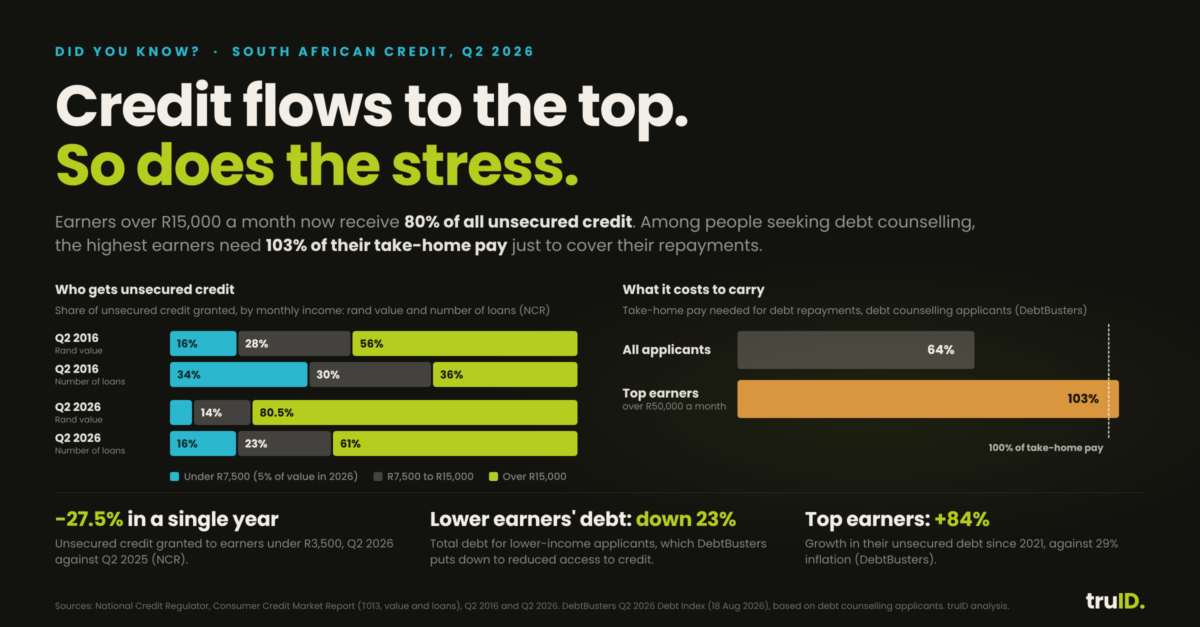
Did you know? 80% of the money lent as unsecured credit in South Africa now goes to people earning over R15,000 a month, and so do 6 in 10 of the loans. Ten years ago it was 56% of the money and about a third of the loans.
This raises a question we can’t fully answer yet. Are higher earners borrowing because they are doing well, or because they are falling behind?
What is unsecured credit? The National Credit Regulator defines it as credit “not secured by any pledge or personal security”. No house, car or deposit stands behind it, which makes it riskier for lenders and more expensive for borrowers. Terms run from a few months to more than five years.
Why do people take it? For two very different reasons. It can be expansionary: a holiday, a new bicycle, home improvements. That spending flows into the economy. Or it can be cautionary: a medical bill or school fees, or rolling several debts into one repayment because the instalments have become too much.
Which is it? The evidence leans towards caution, though not conclusively.
- The loans are getting bigger, over an extended period. The average unsecured loan to someone earning over R15,000 is now R54,900, up from R39,100 in 2016. More than a third of new unsecured lending, by value, now runs for five years or more, against under a tenth in 2016. That looks more like refinancing than shopping.
- The top is stretched. Among people seeking debt counselling, those taking home over R50,000 a month need 103% of their income to cover repayments, according to DebtBusters. Borrowing from several lenders is at its highest since 2016.
- The appetite to spend is weak. Willingness to buy big-ticket items such as furniture and appliances is at an 18-month low (FNB/BER, Q3 2026). Only 37% of consumers in TransUnion’s latest survey say their income is keeping up with inflation.
There is a counterpoint. Arrears on the unsecured book have improved: 19.9% of it is three or more months behind, down from 23% two years ago. Higher earners are still paying. One possible explanation is that they are borrowing to keep up, which keeps accounts current while pressure builds underneath.
Why this is a space to watch. NCR data is a lagging indicator. Loans written today won’t show up as missed payments for six to 24 months. The latest release runs only to June, barely a month after the first of two rate hikes this year. The Reserve Bank has since lifted the repo rate to 7.25%, so these loans now cost more to carry.
If higher earners are borrowing to thrive, the economy gets a lift. If they are borrowing to survive, the strain is coming, just not in this quarter’s numbers. The evidence so far leans towards the second. We don’t think it’s settled, and we’ll be watching the next few releases closely.
Sources: NCR Consumer Credit Market Report, Q2 2016 to Q2 2026. DebtBusters Q2 2026 Debt Index. FNB/BER Consumer Confidence Index, Q3 2026. TransUnion Q2 2026 Consumer Pulse. SARB MPC, 2026.
#ConsumerCredit #UnsecuredCredit #InterestRates #SouthAfrica #truID